Articles ·
Pilgrim Baths Beside the Temple Mount: What the New Ophel Discovery Shows
Archaeologists in Jerusalem's Ophel have uncovered a monumental complex of ritual baths from the days of the Second Temple, and it offers a vivid look at how worshipers prepared to approach God's house.
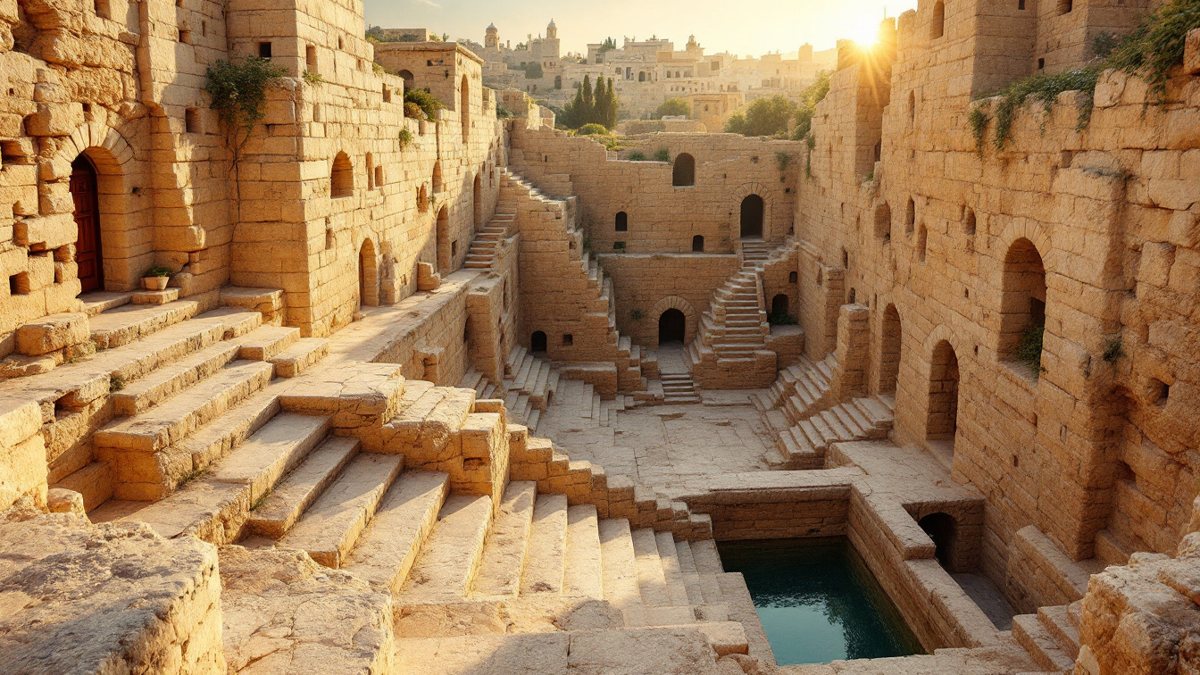
Every so often, a shovel turns up something that makes the pages of Scripture feel close enough to touch. According to ColombiaOne.com, archaeologists have uncovered a monumental complex of ritual baths near Jerusalem's Temple Mount, likely used by Jewish pilgrims nearly 2,000 years ago before they entered the Second Temple.
What was found
The report says the complex lies in the Ophel area of Jerusalem's Old City, near the Triple Gate, which it describes as one of the principal entrances to the Temple Mount in the Second Temple period. Archaeologists from the Hebrew University of Jerusalem's Institute of Archaeology found three large ritual baths, a monumental plastered pool, a paved forecourt and an extensive water system covering about 280 square meters (3,000 square feet).
The central pool measures about 12 by 9.5 meters (39 by 31 feet), with steps descending from all four sides. Northwest of it stands an ashlar building with four rooms, including the three large public baths. According to the article, one bath survives to a height of 4.2 meters (14 feet), complete with a vaulted stone ceiling and a shaft that supplied water.
Drainage channels, in places more than 2 meters (6.6 feet) high, carried water toward the Kidron Valley. The source says their size suggests large volumes of water, possibly from a branch of the aqueduct that supplied the Temple.
A site with layers of history
The monumental complex dates to the early first century CE. Beneath it, researchers found an earlier ashlar-built public complex with a large ritual bath, which they tentatively date to the first century BCE. In other words, according to ColombiaOne.com, public purification at this spot began before the later monumental complex was built.
The excavation was directed by Prof. Uzi Leibner and Prof. Orit Peleg-Barkat. They say the complex's size, design and location suggest it served the large numbers of pilgrims who came to Jerusalem and underwent ritual purification before visiting the Temple.
The story ends with the destruction of Jerusalem. The article reports that dozens of coins from the Jewish revolt were found on the floors and in the destruction debris. That ties the baths to the final phase of the Second Temple period, which ended in 70 CE.
Pilgrims on the road to Jerusalem
The article names Passover, Shavuot and Sukkot as the festivals that drew crowds to the city. Picture pilgrims arriving in Jerusalem and pausing to prepare before going up to worship. The psalmist captured the feeling of those journeys.
A song of ascents. Of David. I was glad when they said to me, “Let us go to the house of the LORD.”
Psalm 122:1 (BSB)
The report also notes that this chronology overlaps with the life of Jesus. It cites the Metropolitan Museum of Art as saying his family went to the Temple shortly after his birth, and that later accounts place him in the Temple as an adult. ColombiaOne.com is careful to add that none of this proves Jesus personally used these baths. We should be just as careful. What the find does show is the Jerusalem landscape in which Jewish pilgrims approached and worshiped at the Temple.
When the Jewish Passover was near, Jesus went up to Jerusalem.
John 2:13 (BSB)
Why it matters
For Jewish readers, this is a tangible link to the devotion of ancestors who took holiness seriously enough to prepare before drawing near to God. For those of us who follow Yeshua, it is another reminder that our faith is rooted in real places, real people and real history, not in myth.
The Bible is true, and discoveries like this remind us how grounded its world is. The Temple has been gone for nearly two thousand years, yet the stones, steps and channels still testify to a people who longed to come near the Holy One of Israel.
This article is our own commentary, based on the report from ColombiaOne.com. As more of the excavation is studied and published, we may learn even more about these pilgrims and the path they walked.
Reporting this draws on: ColombiaOne.com
Scripture: Berean Standard Bible (BSB), public domain. Written by JewTok.com.