Articles ·
A First-Century Road Beneath the Church of the Holy Sepulcher: Could Yeshua Have Walked Here?
Archaeologists in Jerusalem have uncovered a stone-paved road from Yeshua's era, and its possible link to Golgotha invites us to look again at the Messiah's final walk.
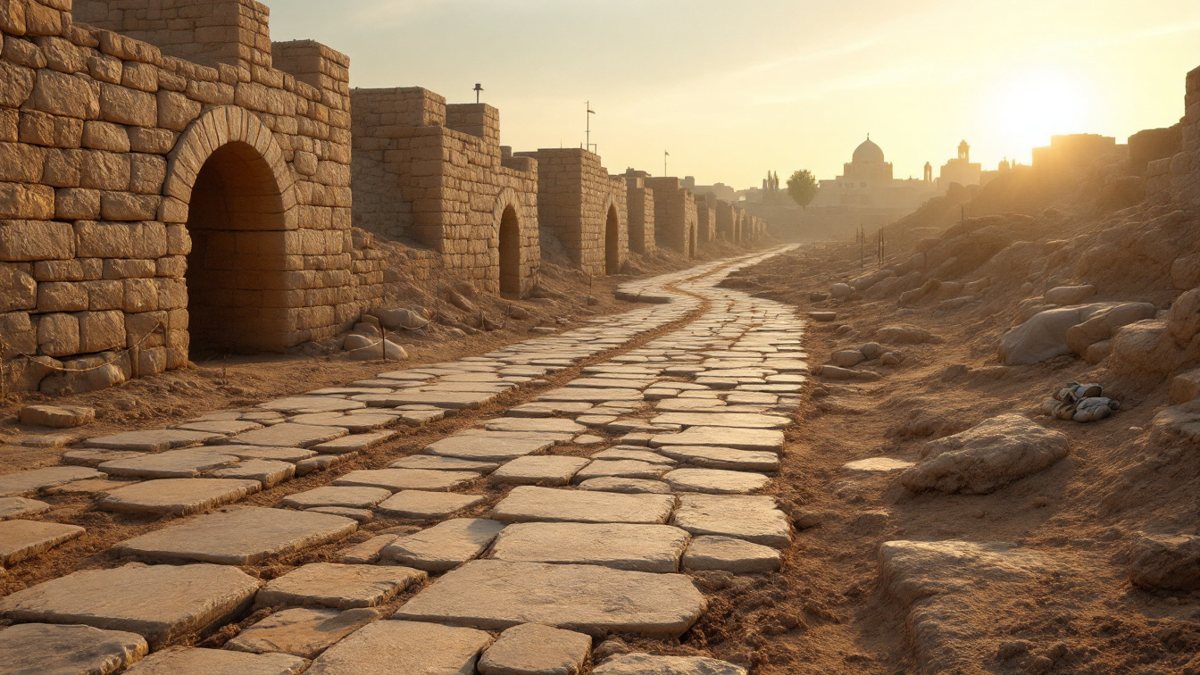
According to UA.NEWS, which cites a Daily Mail report, archaeologists excavating on the grounds of the Church of the Holy Sepulcher in Jerusalem have found a section of an ancient road. One theory holds that Yeshua (Jesus) may have traveled along it about 2,000 years ago on His way to Golgotha.
Let's look at what the report says, what it does not say, and why a stone road can still move the heart.
What the excavation found
According to UA.NEWS, Italian archaeologists uncovered a wide, stone-paved stretch of road dating to the 1st century CE. The preserved section measures roughly 3 by 3.6 meters. It is believed to have run uphill in a southwesterly direction, toward Golgotha.
The report says the road predates the large-scale rebuilding of Jerusalem under the Roman Emperor Hadrian in the 2nd century. That suggests it was already in use during Yeshua's lifetime.
A careful hypothesis
The source is clear that this is not a settled conclusion. Francesca Romana Stasolla of Sapienza University of Rome, who heads the excavation, says it is only a hypothesis for now, though it is possible the road led to Golgotha.
Researchers are also weighing another possibility: that the road carried building materials. But according to the report, its design would have made it hard for loaded carts to travel on it.
The report adds that in ancient Rome, executions were public spectacles. A road able to hold large crowds could therefore have led to a place of execution. It also notes that ancient sources mention mass crucifixions near Jerusalem, but archaeologists have not yet pinpointed the exact site of public executions.
Why this matters for the story
The church itself was built at the initiative of Emperor Constantine and consecrated in 335 CE, according to UA.NEWS. That is about 300 years after Yeshua's death, which the report places around 33 CE. So the site has long been honored by Christians as the place of His crucifixion, burial, and resurrection.
Archaeology cannot prove that the Messiah walked on any particular stone. We should be honest about that, as the excavators themselves are. But the find adds to a picture we already have from the Scriptures: the crucifixion was not a legend from a far-off place. It happened in a real city, along real streets, under real Roman rule.
The Gospel of John says plainly that Yeshua went out, carrying His own cross, to the place called Golgotha.
Carrying His own cross, He went out to The Place of the Skull, which in Hebrew is called Golgotha.
John 19:17 (BSB)
A Jewish story from the start
For Jewish readers, it's worth remembering that this story is rooted in our own Scriptures. Long before that walk, the prophet Isaiah wrote of a suffering servant who would bear the weight of others' sins.
But He was pierced for our transgressions, He was crushed for our iniquities; the punishment that brought us peace was upon Him, and by His stripes we are healed.
Isaiah 53:5 (BSB)
Yeshua, a Jewish teacher from the line of David, walked the roads of His own people's city. He went willingly toward the cross, and God raised Him from the dead. He is the Messiah and Lord. That is the heart of the good news, and it was never meant to be foreign to Israel.
Looking ahead
More study will be needed to see whether this road can be tied to Golgotha, and whether the location of public executions in Jerusalem can be fixed with more confidence. Until then, the discovery is a quiet reminder of how close the past can be, just beneath our feet.
If you are a seeker, you don't need a paved road to meet the Messiah. You can open the Hebrew Scriptures and the Gospels, read them side by side, and ask God to show you the truth. He is faithful to answer those who seek Him with an open heart.
Reporting this draws on: UA.NEWS
Scripture: Berean Standard Bible (BSB), public domain. Written by JewTok.com.