Articles ·
A 2,000-Year-Old Aqueduct Near Jerusalem Gives Us a Glimpse of Yeshua's World
Archaeologists have uncovered a section of an ancient waterway that carried water from near Bethlehem to the Temple Mount, and it points us toward the living water Yeshua offers.
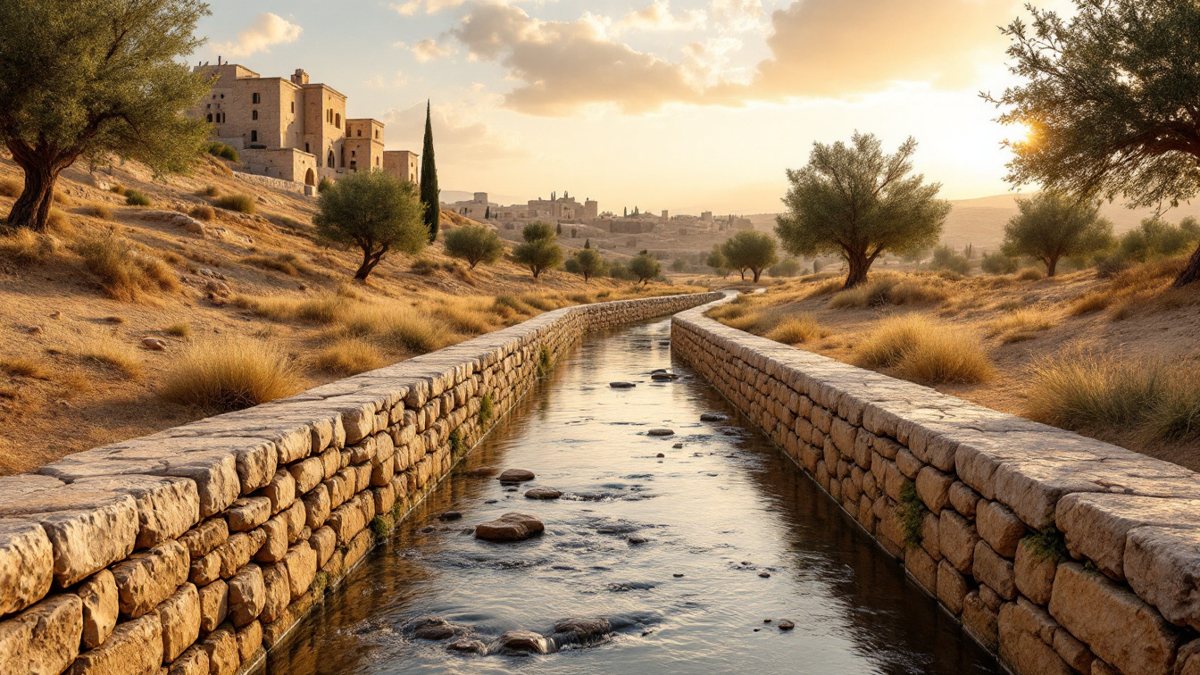
Sometimes the Land itself seems to speak. According to Fox News, archaeologists in Israel have uncovered a roughly 984-foot section of an ancient aqueduct south of Kibbutz Ramat Rachel, near Jerusalem. The channel once carried water toward the Temple Mount.
What was found
Fox News reports that the Israel Antiquities Authority (IAA) announced the discovery on Oct. 11. The dig took place ahead of a planned residential development.
The waterway is known as the Lower Aqueduct. The excavation directors, Benyamin Storchan, Gil Freid and Rotem Cohen, said it was "probably built in the time of the Hasmonean kings to supply water to Jerusalem." According to the IAA, it stayed in intermittent use until about a century ago.
The directors said the aqueduct runs about 21 km (13 miles) from Solomon's Pools, south of Bethlehem, to Jerusalem. Along most of the route, the water flowed along a very gentle gradient, dropping just one meter (3.3 feet) in elevation per kilometer (0.6 miles). Fox News notes that it relied on gravity.
The aqueduct will be preserved and built into the main entrance of the planned development, so visitors can see the ancient engineering for themselves.
Water for the Temple
The water was not only for daily needs. According to the report, it was carried to the Second Temple complex, the center of Jewish religious life at the time. There it was used for ritual purification and for cleaning up after sacrifices.
Douglas Estes, an associate professor of religion at New College of Florida, told Fox News Digital that "the engineering that was required to make this work is really amazing." He compared the importance of such infrastructure to that of modern skyscrapers.
Estes also pointed out that the Hasmoneans, Jewish rulers, were building this aqueduct at the same time the Romans were building their own aqueduct to the Temple of Jupiter on Capitoline Hill. In his words, we often think of Rome as the great power and Jerusalem as a small city-state, but "they were actually advancing in technology at the same time."
Did Yeshua drink this water?
Estes told Fox News he is "confident" that Jesus, his disciples and other early followers would have used water supplied by the aqueduct. The report is careful to add that direct archaeological evidence of their individual use has not been established. That is an honest distinction. We can say the aqueduct belonged to the world Yeshua walked in, but no one has found a cup with his name on it.
The Temple was also the setting for the account of Yeshua cleansing the Temple, when he overturned the tables of the money changers and drove out merchants, as Fox News notes.
When the Jewish Passover was near, Jesus went up to Jerusalem. In the temple courts He found men selling cattle, sheep, and doves, and money changers seated at their tables. So He made a whip out of cords and drove all from the temple courts, both sheep and cattle. He poured out the coins of the money changers and overturned their tables. To those selling doves He said, “Get these out of here! How dare you turn My Father’s house into a marketplace!”
John 2:13-16 (BSB)
Living water
Estes highlighted the symbolism of fresh, "living" water. He said the aqueduct "brought living water from Bethlehem to the Temple Mount, so that sanctification could take place after sacrifice." He added that for Christians, Jesus is the living water, who came from Bethlehem to become the temple and to offer the sacrifice of himself for all people.
That image runs deep in the Scriptures. The Hebrew prophets spoke of drawing water from the wells of salvation, and Yeshua spoke to a woman at a well about water that satisfies forever. For a Jewish seeker, this is not a foreign idea. It grows straight out of Israel's own story of cleansing, nearness to God and the Temple.
But whoever drinks the water I give him will never thirst. Indeed, the water I give him will become in him a fount of water springing up to eternal life.”
John 4:14 (BSB)
There is something moving about a quiet channel, built by human hands and fed by gravity, carrying water over 13 miles toward a place of worship. People worked hard so that others could be made clean and come near to God. Yeshua came to do what no aqueduct could do, and to make a way for us to draw near.
As Estes put it, "There is a rich symbolism that we see here in this aqueduct." We are glad to see this piece of the ancient world preserved, and glad for every reminder that the Scriptures are rooted in real places and real history.
This article is original commentary based on reporting by Fox News and does not replace the full report or the IAA's own statements.
Reporting this draws on: Fox News
Scripture: Berean Standard Bible (BSB), public domain. Written by JewTok.com.